
Skip to content
Download
P0 Founding people

Four peoples, four geographies

Your people decides where you settle with ease, where every work costs you more, and what you will have to go and fetch elsewhere. It is your first choice, and it is final.

P1 Elarans

No one asks them where they come from, only which way they came.

They can settle almost anywhere, without being perfectly suited to anywhere.

No one knows when the Elarans left, because there was no departure. There were many, spread far apart, each decided for a reason unrelated to the last — a failed harvest, a debt, a family quarrel, a shipowner who thought the next system over looked better than this one. The home world emptied over so long a span that no one aboard ever felt they were emigrating.

They found the corridor while looking for a shorter route, and it made no story for anyone. A crew came back with a survey, sold it, then sold it again. It stayed a shipowners' affair for as long as it took for a good part of the people to be living on it.

They spread the way a road spreads: sideways, stopping wherever there was something to stop for, never deciding that one place was better than another. Not one of their worlds bears the name of a place. They bear the names of people — whoever paid for the crossing, whoever died on the way, whoever signed the first lease — and the date of arrival. An Elaran land register reads like a crew list.

They touched the other three peoples before those three touched one another, and they made no account of it: they were customers. Of the home world there remains a rumour, circulating in several versions that do not agree. No one has ever funded the voyage that would settle it.

Where they live
Temperate worlds, where you build under open sky and all four resources come up at once without any of them being plentiful.
What they open
Almost nothing is closed to them, and their ordinary world produces a little of everything: they are the fallback supplier of the whole galaxy, and the one people who need conquer no one to live.
What it costs
No world of their own, no resource mastered. On every ground, a specialist does better for less. Their advantage is breadth, never depth.
P2 Mareth

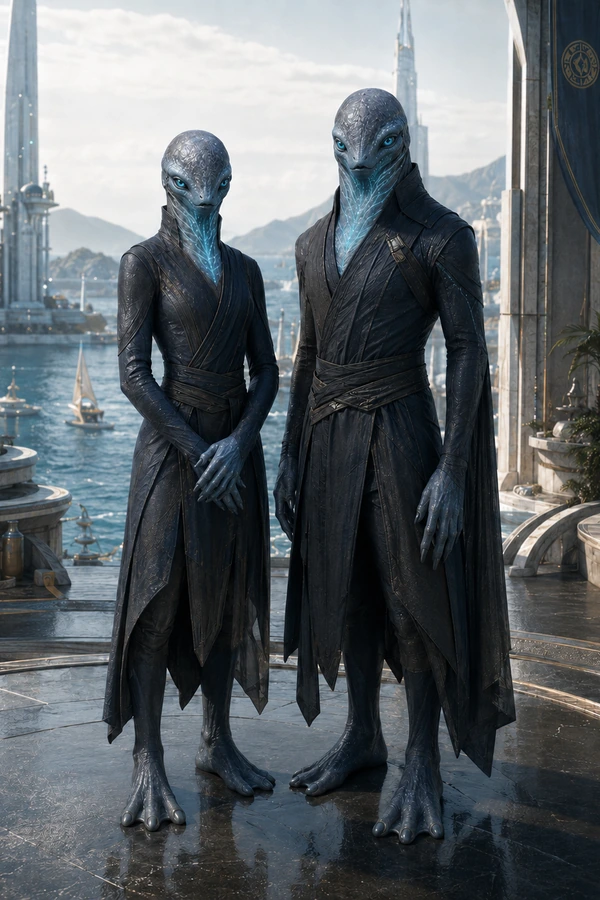
Their cities float, and their fortune lies at the bottom.

Their cities hold the surface of ocean worlds, in the middle of the busiest routes, and everything that keeps them alive comes up from below.

Among the Mareth, everything that matters is below and everything that is decided is above. Their cities hold on the water — platforms welded to one another until they make districts, then ports, then capitals one crosses on foot without once touching land. What feeds them and what warms them, on the other hand, comes up from the bottom: works set far beneath the hull, held by crews who go down for whole seasons and come back saying little.

They did not have to look for the threshold. Their worlds are where there is liquid water, which is to say where everyone passes: the traffic came to them without their asking for any of it. A shipowner crossing the temperate zone always ends up putting in with the Mareth, because that is where there is a quay, water, and someone to argue the price.

That is what made their fortune and it is what exposes them. A city set on the water is seen from very far off and hides nowhere. So they learned to deal before fighting, and to prefer a lukewarm agreement to a good reason — which the other peoples take sometimes for wisdom and sometimes for calculation.

Their culture is made of sound, because below the surface light does not carry and the voice carries far. They name a place after what is heard there, and their words are long and liquid. The name they give themselves is a chord of several voices; « Mareth » is what is left of it when a single throat tries to say it.

Where they live
The ocean worlds of the temperate zone — cities built on the water, and extraction works set on the seabed.
What they open
The most populous cities anyone knows, so the largest crews, and a food surplus that weighs on everyone else. The bed of their seas also yields enough to heat a whole world, and no one crosses the temperate zone without putting in with them.
What it costs
Neither metal nor iridium, so a permanent dependence on those who dig rock. And their cities stand in the open on the most coveted worlds: they are seen from far off, they can be berthed at, and nothing shelters them from what passes overhead.
P3 Skarn

What they build, their great-grandchildren will maintain.

They inhabit the heaviest worlds, the costliest to take, but every loss is counted in generations.

Their world lets nothing rise. Weight brings everything back down — rain, dust, bodies, any machine anyone tries to lift off it. The Skarn knew very early where the door was: it can be calculated, two stars and patience are enough, and patience they had. They knew at the same time that they had nothing to climb to it with.

They went about it as they go about everything. The ramp was cut for generations before there was anything to set on it, and the first launcher able to leave the well was begun by people who knew they would not see it go. The records of that time barely mention the corridor. They speak of formwork, of tolerances, of shift changes.

Once out, they did not scatter. Leaving cost too much to be done twice: every departure was calculated to be the last, every world chosen to hold. Where others sowed trading posts, the Skarn set down a few very heavy cities, very far apart, and never left them again.

They met no one. Their territory grew until it touched someone else's, and on that day there was neither ceremony nor battle — two administrations discovered they were surveying the same rock.

Where they live
Massive worlds and bared planetary cores — the dead rocks nobody wants, and where the iridium is.
What they open
They naturally inhabit the class of worlds no one disputes with them, and their homes are gravity wells costly to invade and ruinous to hold. They are the anvil.
What it costs
No food, and so few crews, and a population that takes generations to rebuild: a defeat is not made good. Their fleets are dear to launch before they are even dear to build.
P4 Vorn

Daylight burns their eyes. They have learned to read the dark.

They live on the moons of the giants, at the threshold of systems, where every arrival passes.

The threshold opens far from the star, where space is flat enough — which is to say above the outer orbits, where the Vorn have always lived. They did not have to look for the door. It lay at the end of a supply run.

Their sun is weak, their moons are past counting, and they see in wavelengths where, for everyone else, there is nothing to see. The magnetospheres of the giants above which they are settled radiate powers they had long been making antimatter from, without knowing all that time that they were manufacturing exactly what it takes to cross a threshold. The first passage cost neither a generation nor a fortune: one more manoeuvre at the end of a run crews were already making.

What cost them was what followed. Their homes are rocks of a few plots, it takes many to be worth a world, and nothing is near anything — Vorn reinforcements always arrive after. They name places by distance and by the light found there, so that a Vorn name is an address before it is a name. When the other peoples finally came, they came by the threshold, which is to say through the Vorn's front door, and they were seen long before they saw anything.

Where they live
The moons of gas giants, in systems with a weak star. They inhabit no planet: many small objects rather than one large one.
What they open
Nothing enters their space without passing their orbits: they sit permanently on the interception line, to receive as much as to depart. And one arrives in their systems late, blind and empty.
What it costs
Their home is their rampart, so it takes the first shock of every incursion. Neither food nor iridium, many points to defend, and everything is far — including their own reinforcements.