


Skip to content
Odyssea Home Open beta fren Play
Persistent space strategy

Your empire.
Your decisions.
Your galaxy.

Settle your first colony, build your first fleet, and see how far you can push, in a galaxy you share with every other player.

Open beta, in your browser. No sign-up to start.

Deadlines
Metal mine 2 · Sundal IV47 s
Antimatter thrust 31 h 40 min
Habitat 6 · Casalos II6 h 5 min
Sundal IVCapital
Metal mineLevel 1
Iridium extractorLocked
Antimatter converterNot yet laid down
Agricultural complexLevel 2
Power plantLevel 2
WarehouseNot yet laid down
Command centreNot yet laid down
Metal mineLEVEL 1 → 2

Metal mine1 → 247 s
What it gives
Metal198 / h → 436 / h
What it takes
Power10 / 12
Hands105 / 1,000
WorksHead of production · Sundal IV
Metal mine, level 2We have just improved metal production on Sundal IV: we now produce 238 more per hour.
01 · Your commanders

When you're not there,
they decide.

You train your commanders and write them a programme. When the enemy shows up, they follow it without waiting for you, then send you their report.

CommandersFile · Programme
ElaransCasalos II
Fevaldol
Commander · Level 4 · Casalos II · 9 hulls
14Tactics
9Navigation
6Logistics
11Authority
On campaign
When the enemy is judged at least 2 times strongerFall back on the home world
When the escorted convoy is threatenedStand between the convoy and the threat
In battle
When the enemy fields squadrons or carriersTarget enemy squadrons
When losses exceed 40%Break off
In place
When an enemy war fleet stops in orbitTarget the biggest hull
MilitaryFevaldol · Level 4
Pirate fleet destroyed · level 3Our losses: 8% (1 hull). Theirs: 100%. The debris field: 3,400 metal, 900 iridium.
02 · The galaxy

The whole map
is a battlefield.

You can strike anywhere your ships go: an ambush at the edge of a system, a cut freight route, a fleet caught above a moon. An hour of flight there lasts a real hour.

  • The other playersThey share your galaxy. You can ally with them, and betray them when it suits you.
The galaxy
YUVERSUNDAL IVCASALOS IIVELSA VII12 HULLS · 14 MIN AGOSINVIEN I
System
Sinvien I

2 h 10 min from your fleet · Casalos II

Military fleet · 12 hullsSeen 14 min ago · unknown empire
03 · Founding people

Four peoples,
four geographies.

Your people decide where you settle with ease, where every building costs you more, and what you will have to fetch elsewhere. It is your first choice, and it is final.

Founding people
Elarans
ElaransTemperate terrestrial

No one asks them where they come from, only which way they came.

They can settle almost anywhere, without being perfectly suited to anywhere.

Almost nothing is closed to them, and their ordinary world produces a little of everything: they are the fallback supplier of the whole galaxy, and the one people who need conquer no one to live.

No world of their own, no resource mastered. In every field, a specialist does better for less.

No one knows when the Elarans left, because there was no departure. There were many, spread far apart, each decided for a reason unrelated to the last: a failed harvest, a debt, a family quarrel, a shipowner who thought the next system over looked better than this one. The home world emptied over so long a span that no one aboard ever felt they were emigrating.

They found the corridor while looking for a shorter route, and nobody made a fuss about it. A crew came back with a survey, sold it, then sold it again. It stayed a shipowners' affair for as long as it took for a good part of the people to be living off it.

They spread the way a road spreads: sideways, stopping wherever there was something to stop for, never deciding that one place was better than another. Not one of their worlds bears the name of a place. They bear the names of people (whoever paid for the crossing, whoever died on the way, whoever signed the first lease) and the date of arrival. An Elaran land register reads like a crew list.

They met the other three peoples before those three met one another, and made no story of it: they were customers. Of the home world there remains a rumour, circulating in several versions that do not agree. No one has ever funded the voyage that would settle it.
Colonial conditions
NativeTemperate terrestrial
NaturalOcean world
DifficultArid rocky · Frozen world · Giant's moon · Moon
HostileChthonian planet · Toxic world · Volcanic world
Population growthModerate
Mareth
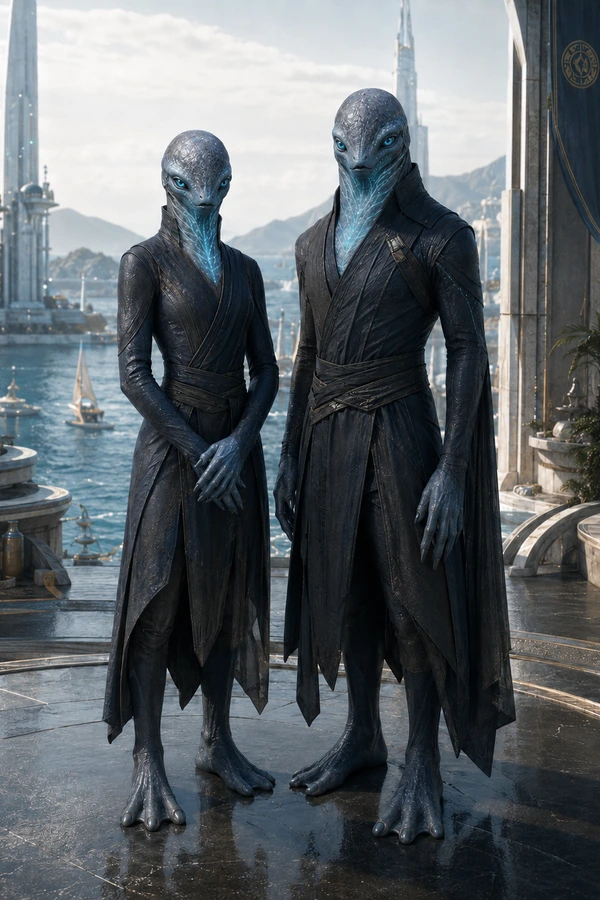
MarethOcean world

Their cities float, and their fortune lies at the bottom.

Their cities hold the surface of ocean worlds, in the middle of the busiest routes, and everything that keeps them alive comes up from below.

The most populous cities anyone knows, so the largest crews, and a food surplus that weighs on everyone else. The bed of their seas also yields enough to heat a whole world, and no one crosses the temperate zone without putting in with them.

Neither metal nor iridium, so a permanent dependence on those who dig rock. And their cities stand in the open on the most coveted worlds: they are seen from far off, anyone can dock there, and nothing shelters them from what passes overhead.

Among the Mareth, everything that matters is below and everything that is decided is above. Their cities stand on the water: platforms welded to one another until they make districts, then ports, then capitals one crosses on foot without once touching land. What feeds them and what warms them, on the other hand, comes up from the bottom: works set far beneath the hull, held by crews who go down for whole seasons and come back saying little.

They did not have to look for the threshold. Their worlds are where there is liquid water, which is to say where everyone passes: the traffic came to them without their asking for any of it. A shipowner crossing the temperate zone always ends up putting in with the Mareth, because that is where there is a quay, water, and someone to haggle with over the price.

That is what made their fortune and it is what exposes them. A city set on the water is seen from very far off and hides nowhere. So they learned to deal before fighting, and to prefer a lukewarm agreement to a good reason, which the other peoples take sometimes for wisdom and sometimes for calculation.

Their culture is made of sound, because below the surface light does not carry and the voice carries far. They name a place after what is heard there, and their words are long and liquid. The name they give themselves is a chord of several voices; « Mareth » is what is left of it when a single throat tries to say it.

Colonial conditions
NativeOcean world
NaturalTemperate terrestrial
DifficultFrozen world · Giant's moon · Moon
HostileArid rocky · Chthonian planet · Toxic world · Volcanic world
Population growthFast
Skarn
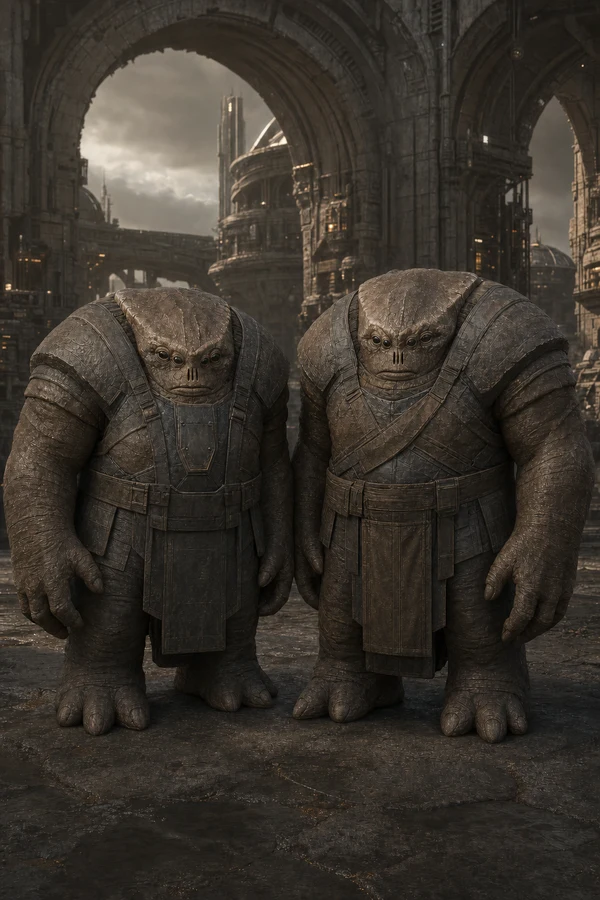
SkarnChthonian planet

What they build, their great-grandchildren will maintain.

They inhabit the heaviest worlds, the costliest to take, but every loss is counted in generations.

They naturally inhabit the class of worlds no one disputes with them, and their homes are gravity wells costly to invade and ruinous to hold.

No food, and so few crews, and a population that takes generations to rebuild: a defeat is not made good. Their fleets are dear to launch before they are even dear to build.

Their world lets nothing rise. Weight brings everything back down: rain, dust, bodies, any machine anyone tries to lift off it. The Skarn knew very early where the door was: it can be calculated, two stars and patience are enough, and patience they had. They knew at the same time that they had nothing to climb to it with.

They went about it as they go about everything. The ramp was cut for generations before there was anything to set on it, and the first launcher able to leave the well was begun by people who knew they would not see it go. The records of that time barely mention the corridor. They speak of formwork, of tolerances, of shift changes.

Once out, they did not scatter. Leaving cost too much to be done twice: every departure was calculated to be the last, every world chosen to hold. Where others sowed trading posts, the Skarn set down a few very heavy cities, very far apart, and never left them again.

They met no one. Their territory grew until it touched someone else's, and on that day there was neither ceremony nor battle: two administrations discovered they were surveying the same rock.

Colonial conditions
NativeChthonian planet
NaturalVolcanic world
DifficultArid rocky · Ocean world · Temperate terrestrial
HostileFrozen world · Giant's moon · Moon · Toxic world
Population growthVery slow
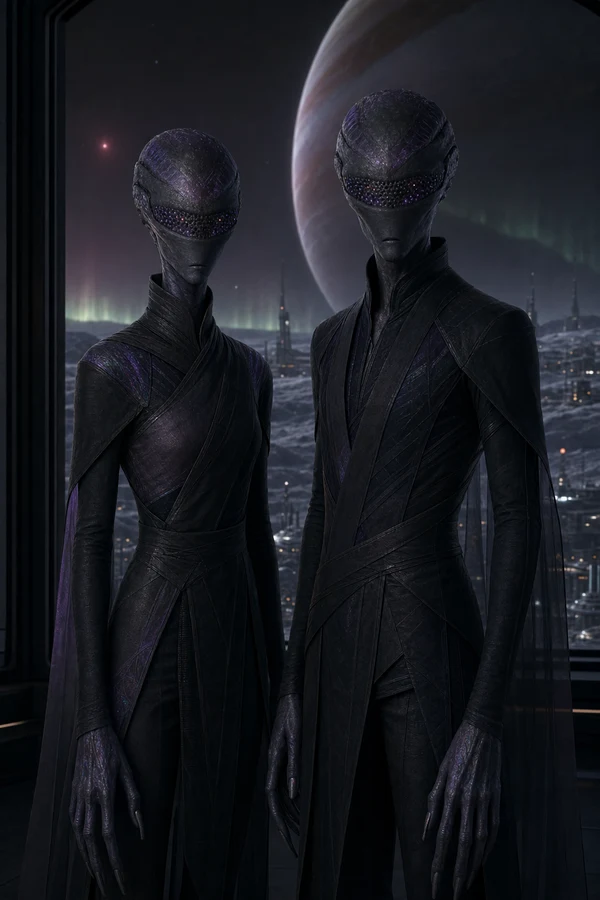
Vorn
VornGiant's moon

Daylight burns their eyes. They have learned to read the dark.

They live on the moons of the giants, at the threshold of systems, where every arrival passes.

Nothing enters their space without passing their orbits: they sit permanently on the interception line, to receive as much as to depart. And one arrives in their systems late, blind and empty.

Their home is their rampart, so it takes the first shock of every incursion. Neither food nor iridium, many points to defend, and everything is far away, their own reinforcements included.

The threshold opens far from the star, where space is flat enough, which is to say above the outer orbits, where the Vorn have always lived. They did not have to look for the door. It lay at the end of a supply run.

Their sun is weak, their moons are past counting, and they see in wavelengths where, for everyone else, there is nothing to see. The magnetospheres of the giants above which they are settled radiate powers they had long been making antimatter from, without knowing all that time that they were manufacturing exactly what it takes to cross a threshold. The first passage cost neither a generation nor a fortune: one more manoeuvre at the end of a run crews were already making.

What cost them was what followed. Their homes are rocks with a few plots each; it takes many to be worth a world, and nothing is near anything: Vorn reinforcements always arrive late. They name places by distance and by the light found there, so that a Vorn name is an address before it is a name. When the other peoples finally came, they came by the threshold, which is to say through the Vorn's front door, and they were seen long before they saw anything.

Colonial conditions
NativeGiant's moon
NaturalFrozen world
DifficultMoon · Ocean world · Temperate terrestrial
HostileArid rocky · Chthonian planet · Toxic world · Volcanic world
Population growthSlow
04 · Desktop and phone

One empire,
two stations.

On a computer, you rule your empire through windows, the map and your registers. On your phone, you react wherever you are, and find your empire exactly as it stands this second.

The desktop · in your browser
The phone · iOS and Android, soon
05 · What's new

What changed
in the game.

What's new can also be read in the game. Play

Everything new
A new presence

The rest is unwritten.

You are not arriving too late. Your first world is waiting, and what it becomes will depend on you alone.